We hope that these musical definitions help to guide your listening. To learn extra terms, click here.
Musical Definitions
Concerto: A concerto is a work for an instrumental soloist plus an orchestra or group of musicians.
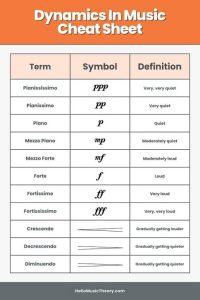
Dynamics: Markings to indicate intended loudness or softness of the music.
Melody/Harmony: Melody is the main recognizable tune in a piece of music, while harmony refers to additional complementary note(s) played or sung at the same time.
Movement: A section of a larger composition made up of several significant sections, such as a concerto or symphony. In most cases, the orchestra will pause briefly between movements, but applause is often reserved until the end of the entire work.
Overture: Overtures are the introductory number in larger musical compositions such as operas, suites, or oratorios. They are instrumental rather than inclusive of the vocalists that are part of the rest of the work that follows.
Repertoire: The body of compositions that a performer or group is prepared to perform. Within Landmarks, we aim to feature a mix of classics with more diverse repertoire, like world music.
Requiem: A Catholic Mass for the dead, originally intended for funeral services. The Requiem Mass has inspired many musical compositions over the centuries. From the 18th Century onwards, various composers were inspired to score their versions for choral and orchestral forces so massive — some practically operatic — that they couldn’t possibly be performed as part of a normal funeral. These became concert works, and the ‘Requiem’ evolved into a genre all of its own. Verdi’s Requiem was featured this year within the Landmarks season.
Score: Musical notation of all of the musical parts of a piece in a single document, aligned vertically on the page so that the conductor can see every player’s part simultaneously. You may notice music director and conductor Christopher Wilkins’ stand with the giant piece of music he refers to while the orchestra is playing- that is his score!
Suite: An ordered set of individual pieces or movements, tied together by themes or tonalities.
Symphony: The word symphony comes from the Greek word Symphonia, which means “agreement or concord of sound”. Often a symphony orchestra is called a “symphony” for short, but the primary meaning is based on a large-scale composition for orchestra called a symphony. The symphony is an extremely important classical music genre and most of the famous composers of the last several centuries have written symphonies as part of their life’s work. Older symphonies often had only three movements, fast, slow, and fast again. More modern symphonies by famous composers such as Beethoven, Brahms, and Mozart are generally in four movements that follow a set pattern:
Fast, but sometimes with a slow introduction, often in sonata form
Slow, such as Adagio, Andante, or Largo
Moderately fast and dance-like, using a Minuet or Scherzo
Fast, often Allegro or Allegretto, Rondo, or Sonata
Of course, like for every other musical form there are notable exceptions. But the symphony will always be a major orchestral work requiring a full-sized orchestra for its performance.
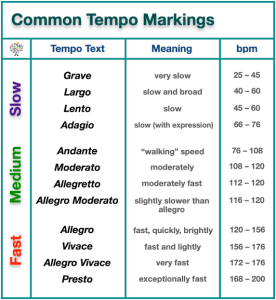
Tempo: Italian for ‘time’, tempo is the speed at which a piece of music is to be played.